


Risk Perspectives in Small Cap Growth: When Underexposure Becomes a Risk

Head of Small Cap Growth, Portfolio Manager

Client Portfolio Manager, Small Cap Growth

Success in small caps increasingly depends on position sizing, as concentrated winners amplify the cost of underexposure.
Bigger positions, bigger consequences
When considering risks in portfolios, managers often focus on mitigating “downside risk”—the risk of losing money. But managers must also consider “upside risk”— having little or no exposure to stocks of fast-growing companies that achieve meaningful benchmark weights.
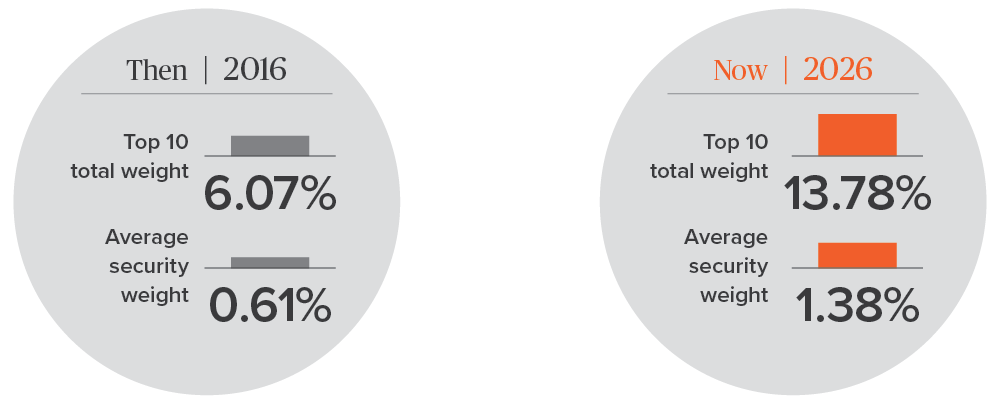
Faster information flow, intense investor attention, and momentum around transformational technologies such as artificial intelligence (AI) can quickly push a stock from a modest index weight to a major driver of returns. For an active manager, position sizing decisions can have an increasingly meaningful effect on portfolio outcomes— especially as small cap indexes have become more concentrated (see chart).
As of 06/25/26. Source: FactSet.
As benchmark weights rise, so does relative risk
Excluding larger benchmark constituents on valuation grounds alone can increase the risk of meaningful underperformance. For example, in the momentum-driven market of 2025, the average small cap growth manager underperformed the Russell 2000 Growth Index by 5.22%.
The culprit? Many of the strongest performers that year initially screened as expensive, but they appreciated rapidly through a combination of AI exposure and accelerating revenue and earnings growth.
The importance of position sizing decisions extends beyond a single market cycle. Small caps have historically generated higher earnings growth than large caps over long periods of time, yet they currently trade at a substantial valuation discount. Missing participation in the companies driving that growth can therefore carry meaningful opportunity cost for investors.
Case study: Bloom Energy (BE) In mid-2025, Bloom Energy’s fundamentals were improving rapidly due to the company’s emergence as a mission-critical power infrastructure partner for AI hyperscalers, and we believed its growing benchmark weight warranted attention. However, at first glance, its valuation did not fully fit our traditional growth-at-a-reasonable-price discipline. Rather than ignore the opportunity, we scrutinized the fundamentals, formed a favorable opinion of the revenue growth prospects for the company, and realized valuation was not as stretched as the initial screen would have indicated. Therefore, we established a slightly overweight position that provided exposure to the opportunity in line with our level of conviction. This was an active decision grounded in research, not a reaction to price momentum alone. |
Small caps demand a more dynamic approach to position sizing
We believe small cap growth remains an attractive option for three reasons:
- Opportunities to broaden diversification and reduce concentration risk
- Strong earnings potential at discounted valuations relative to large caps
- Benefits when company-specific or market catalysts improve
To capture increasingly dynamic opportunities in small caps, we believe managers can’t assume that yesterday’s position sizing conventions will remain sufficient as benchmark weights change more rapidly. Fully capturing the long-term opportunity in small caps increasingly depends on the ability to assess both upside and downside risk and adjust position sizes accordingly.